NFL TD Odds Boost Strategy: How to Tell Real Value from Marketing Noise
 Available in US
Every Sunday during the NFL season, my phone lights up with notifications from UK bookmakers promoting enhanced odds on touchdown scorer props. “Star RB to score anytime — was 1.80, NOW 2.50!” The promotions are designed to feel irresistible, and for many punters, they are. But after three seasons of systematically tracking odds boosts on NFL TD props, I’ve learned that the gap between a boost that looks good and one that is good is often the difference between the bookmaker giving away value and the bookmaker buying your attention at a price that still favours them.
Anatomy of a TD Odds Boost
An odds boost is a promotional enhancement where a bookmaker offers improved odds on a specific market. For NFL TD props, this typically means a player’s anytime TD odds are enhanced from their standard price to a higher number. The boost applies to a single bet at a maximum stake — usually capped between £10 and £50 — and is available for a limited time.
The mechanics are simple, but the economics behind them are more interesting. Bookmakers use boosts as customer acquisition and retention tools. The cost of offering a genuinely favourable boost on a single bet is small relative to the marketing value — a punter who logs in to place the boosted bet might then place several additional bets at standard odds, generating margin that more than covers the boost’s cost. This is the business model, and understanding it helps you evaluate boosts rationally rather than emotionally.
The boost itself isn’t inherently good or bad. It’s a repricing of a specific market, and like any repricing, it can be evaluated on its mathematical merits. The question isn’t whether the enhanced odds are higher than the standard odds — of course they are, that’s the point — but whether the enhanced odds exceed the true probability of the outcome, which would make them positive expected value.
How to Evaluate Whether a Boost Is Real Value
The evaluation process is the same implied probability check you should be running on every TD bet, boosted or not. The anytime TD scorer prop remains the most popular player prop by betting volume, which means bookmakers have strong incentive to build eye-catching boosts around it. Your job is to see past the presentation and into the maths.
Start with the boosted price. Convert it to implied probability by dividing 1 by the decimal odds. A boost to 3.00 implies a 33.3% scoring probability. A boost to 2.50 implies 40%. Now compare that implied probability to the player’s actual scoring rate. Use his last six to eight games as the reference window — long enough to smooth out variance but recent enough to reflect current usage patterns.
If the player’s actual TD rate over that window exceeds the implied probability of the boosted odds, the boost has positive expected value. If the actual rate falls below the implied probability, the boost is still overpriced — the bookmaker just made it less overpriced than the standard line. The second scenario is by far the more common one. In my tracking, roughly 60% of NFL TD boosts from UK bookmakers fall into the “less overpriced but still negative EV” category. They look generous but don’t survive the maths.
A common trap is evaluating the boost relative to the standard odds rather than relative to fair value. A boost from 2.00 to 2.80 feels like a 40% improvement, and psychologically, that feels generous. But if the player’s true scoring probability implies fair odds of 3.20, the boosted price is still below fair value — less so than the standard price, but still negative EV. The reference point must always be your own probability estimate, never the bookmaker’s unboosted line. The bookmaker’s standard price already contains their margin, so improving it doesn’t necessarily push it past the fairness threshold.
The remaining 40% that do pass the value check are genuine opportunities. They tend to cluster around a few patterns: star players who are already strong TD candidates getting boosted past their fair value, less prominent players whose standard odds are already soft getting boosted into genuinely generous territory, and situational boosts tied to specific matchups where the implied probability of the standard line was already marginal.
UK Bookmaker Boost Patterns for NFL TD Props
Different UK bookmakers use boosts differently, and recognising the patterns helps you prioritise which promotions to evaluate each week. With 10% of UK adults betting on sports online, the competition for their attention drives distinct promotional strategies across operators.
Some operators boost star players on high-profile games almost exclusively. These are the most visible boosts but often the least valuable, because the standard odds on star players in marquee games are already tightened by public money. Boosting an already sharp line often doesn’t move the price far enough past fair value to create genuine edge.
Other operators take a broader approach, boosting lesser-known players or offering multiple TD boosts across the Sunday slate. These promotions are less eye-catching but more likely to contain value, because the standard odds on less popular players tend to be softer — there’s more room to boost before hitting the fair value threshold.
The most analytically interesting boosts come during playoff and Super Bowl windows, when bookmakers compete most aggressively for handle. The promotional budgets expand during these periods, and the boosts become more generous. I’ve found the highest concentration of positive-EV TD boosts in the two weeks before the Super Bowl, when every major UK operator is running multiple enhanced-odds promotions simultaneously.
One pattern worth watching for is the “loss leader” boost — a genuinely generous enhancement on a popular player designed to drive app traffic, paired with mediocre standard pricing on everything else. The bookmaker loses margin on the boosted bet but recovers it through the additional volume the promotion generates on standard-priced markets. For the disciplined punter, the correct response is to take the valuable boost and then shop other operators for any additional bets rather than placing them on the same platform at standard odds. Use the promotion for what it’s worth and then leave — the bookmaker is hoping you’ll stick around, and your edge comes from not obliging.
Regardless of the operator, the evaluation process doesn’t change. Convert, compare, and only back boosts that survive the probability check. The promotion is a pricing decision by the bookmaker, and you evaluate pricing decisions with maths, not with excitement.
Are boosted touchdown odds always better value than standard odds?
Boosted odds are always higher than the standard price, but higher odds don’t automatically mean positive value. Many TD boosts enhance the price from one negative-EV level to a slightly less negative-EV level, which looks generous but still favours the bookmaker. Evaluate every boost by converting the enhanced price to implied probability and comparing it to the player’s actual scoring rate over his last six to eight games.
How do I calculate whether a TD odds boost is genuinely positive expected value?
Divide 1 by the boosted decimal odds to get the implied probability. Then check the player’s touchdown rate over his last six to eight games. If his real scoring rate exceeds the implied probability of the boosted odds, the boost has positive expected value. For example, if the boosted odds are 3.00 (33.3% implied) and the player has scored in 45% of his recent games, the boost carries genuine value.
This material was created by the Endzone Edge team.
Related posts
NFL Playoff Touchdown Props: How Postseason Football Changes the TD Equation
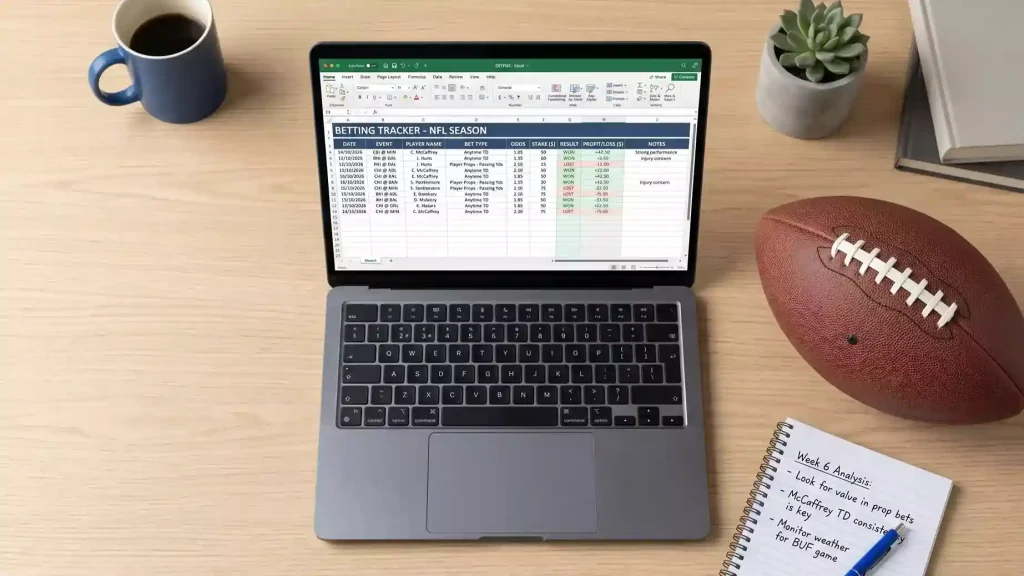
NFL TD Prop Record Keeping: How to Track Your Bets and Measure Your Edge