NFL TD Bets: Top Touchdown Scorer Betting Markets in the UK
 Available in US
I placed my first NFL touchdown bet in a William Hill shop on a grey Saturday in 2017, picking a running back I'd barely watched to score against a defence I knew nothing about. He didn't score. Neither did my next pick, or the one after that. I was doing what most punters do — treating TD props like lottery tickets instead of analysable markets. Nine years later, after building spreadsheets thick enough to crash my laptop and tracking thousands of individual prop outcomes, I can tell you the gap between guessing and grounded analysis in NFL TD bets is wider than any other prop market I've worked.
That gap is also where the opportunity lives. The anytime touchdown scorer bet — where you back a named player to reach the end zone at least once during a game — is the single most popular player prop by betting handle, outstripping receiving yards and rushing totals by a comfortable margin. And it's not hard to see why. The bet is simple to understand, emotionally engaging, and priced attractively enough that both casual fans and serious analysts keep coming back. When 5.2 million people across the UK tuned in for Super Bowl LX, a significant chunk of them had skin in the game through some form of TD wager.
The anytime touchdown scorer market generates more betting handle than any other NFL player prop — more than passing yards, rushing yards, or receptions combined. It's the prop market where casual money and sharp money collide most directly, which means mispricing happens more often than you'd expect.
But popularity doesn't mean the market is efficient. Most English-language guides are written for American audiences, quoting American odds formats and referencing US-only sportsbooks. Everything here — the red-zone data, the implied probability breakdowns, the bookmaker comparisons — is built for punters placing bets through UK-licensed operators, using decimal and fractional odds, and watching NFL action through Sky Sports at inconvenient hours. Whether you're placing your first TD prop or your five-hundredth, the principles are the same: understand the rules, follow the numbers, and never bet more than you can afford to track.
Key TD Market Factors for UK Bettors
- The anytime touchdown scorer is the most heavily bet player prop in NFL markets — and one of the few where systematic analysis consistently outperforms gut instinct.
- 73.9% of all NFL touchdowns originate from the red zone. Red-zone usage data, not yardage stats, is the best predictor of who will score.
- Always convert odds to implied probability (1 / decimal odds) before placing a bet — then compare that number to the player's actual scoring rate against similar defences.
- Line shopping across three or four UK bookmakers on every bet captures pricing differences of 0.20-0.50 in decimal odds that compound across a full season.
- Stake 1-3% of your bankroll per single TD prop, keep accumulators to three legs maximum, and track every bet to measure whether your approach is genuinely profitable.
Types of NFL Touchdown Bets Available to UK Punters
A mate once asked me why his "Patrick Mahomes to score a touchdown" bet lost when Mahomes threw four TD passes in a single game. That conversation — and the look on his face when I explained the quarterback exception — is the reason I start every guide with the bet types. The details matter more than most punters realise, and getting them wrong costs real money.
Anytime Touchdown Scorer — a bet on a named player to score a touchdown by any method (rushing, receiving, fumble recovery, interception return, or kick/punt return) at any point during the game, including overtime. One touchdown is enough. This is the most widely available and most heavily bet TD prop in UK markets.
First Touchdown Scorer — a bet on which player will score the very first touchdown of the game. Higher odds than anytime TD because you're predicting both the scorer and the timing. Dead-heat rules may apply if two players are credited simultaneously.
Last Touchdown Scorer — a bet on who will score the final touchdown. Heavily influenced by game script, clock management, and whether teams are in garbage time. Less commonly offered but available at several UK bookmakers.
2+ Touchdowns — a bet on a player scoring two or more touchdowns in the same game. Significantly higher odds, significantly lower hit rate. Only viable for players with elite goal-line usage.
The distinction that trips up the most people is the quarterback exception. When a QB throws a touchdown pass, the scorer for betting purposes is the receiver who catches the ball in the end zone — not the quarterback. A QB can only win a touchdown scorer bet by rushing for a TD (a designed run or scramble across the goal line) or by catching a pass on a trick play. This rule applies universally across UK bookmakers, and it's the single most common reason first-time NFL bettors lose money on TD props. If you're backing a quarterback, you're betting on his legs, not his arm.
Overtime is included in all anytime touchdown scorer settlements at every major UK-licensed bookmaker I've worked with. For first TD scorer bets, overtime is irrelevant — the first TD has already happened. For last TD scorer, overtime can completely change the outcome.
First TD Scorer
Higher odds, typically 8.00-20.00 decimal. Only the first touchdown in the entire game counts. Dead-heat rules may reduce payouts. High variance, low control. Best approached as an occasional speculative play.
Anytime TD Scorer
Lower odds, typically 1.50-5.00 decimal. Player can score at any point, including overtime. Settled as a winner on the first TD scored. Lower variance, more analysable. The core market for systematic TD betting.
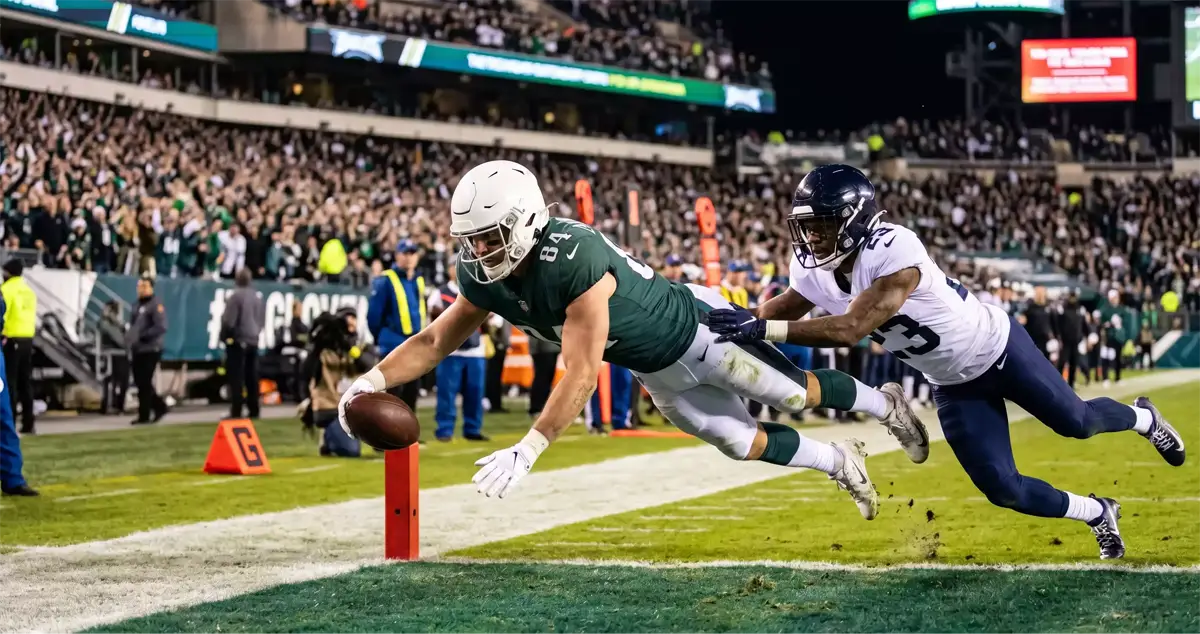
The anytime TD market is where I spend roughly 80% of my TD betting activity, and it's the focus of everything that follows. First TD scorer and last TD scorer markets have their place, but anytime TD offers the best combination of market depth, analytical tractability, and value opportunity for UK punters. The complete breakdown of anytime touchdown scorer rules covers every edge case, from injury voids to defensive touchdowns, in the detail this overview can't.
How to Read NFL Touchdown Odds in the UK
Here's something that took me two full seasons to properly internalise: the odds on a touchdown prop aren't just a price tag — they're the bookmaker's estimate of probability, with a profit margin baked in. Once you learn to read them that way, you stop asking "are these good odds?" and start asking "does this probability match reality?" That shift in thinking is worth more than any individual pick.
UK bookmakers display NFL touchdown odds in two formats. Decimal odds show your total return per pound staked — an anytime TD priced at 2.50 means a successful one-pound bet returns two pounds fifty, including your original stake. Fractional odds, the format most British punters grew up with, show profit relative to stake — the same price expressed as 3/2 means three pounds profit for every two pounds wagered. Both formats contain identical information; decimal is simply easier to compare across bookmakers at a glance, which is why I work in decimal for analysis and convert to fractional only when the context demands it.
Example: Anytime TD Scorer at 2.50 (3/2)
| Stake | Return if successful | Profit |
|---|---|---|
| £10 | £25.00 | £15.00 |
| £25 | £62.50 | £37.50 |
The real power of odds literacy comes from calculating implied probability — the percentage chance the bookmaker's price assigns to an outcome. The formula is straightforward: divide 1 by the decimal odds. At 2.50, the implied probability is 1 / 2.50 = 0.40, or 40%. At 3.00 (2/1), it's 33.3%. At 1.80 (4/5), it's 55.6%. This number is the starting point for every value assessment I make.
Worked Example: Calculating Implied Probability and Spotting Value
Suppose a running back is priced at 1.72 decimal (8/11 fractional) to score anytime. Implied probability: 1 / 1.72 = 58.1%. Now check the data: this player has scored in 12 of his last 17 games — a 70.6% hit rate. The bookmaker's implied probability (58.1%) sits well below the player's actual scoring frequency (70.6%). That gap — 12.5 percentage points — suggests genuine value. Of course, past performance isn't a guarantee, and you'd want to cross-reference with the current week's matchup and red-zone usage. But this is the process: convert odds to probability, compare to data, act on meaningful discrepancies.
One thing that catches UK punters off guard is the bookmaker margin — sometimes called overround or vig. The implied probabilities across all outcomes in a market sum to more than 100%, and that excess is the bookmaker's built-in edge. On TD prop markets, the overround runs 10-20%, which means implied probability overstates the true chance of each outcome. The full guide to NFL touchdown odds covers how to strip out the margin and find cleaner probability estimates.
Why Red-Zone Data Is the Foundation of Smart TD Betting
Three years ago I ran a project where I tracked every single touchdown scored across an entire NFL season and tagged each one with the yard line where the scoring drive entered the red zone. The result was so lopsided it changed how I approach every TD prop I evaluate: 73.9% of all touchdowns in the NFL since 2010 have come from inside the opposing 20-yard line. Not roughly. Not approximately. Nearly three quarters of all touchdowns start from that narrow strip of field that coaches call "scoring territory."
Nearly half of all red-zone touchdowns — 47.3% — are scored from the five-yard line or closer. The goal line isn't just symbolically important; it's where the mathematical probability of scoring spikes dramatically, and where the players who get the ball most often become the strongest TD prop candidates.
That single data point reshapes everything. If you're betting on a player to score a touchdown, the first question isn't "how many yards does he gain per game?" or "how many targets does he get?" — it's "how often does he touch the ball inside the 20?" Red-zone usage is the closest thing to a predictive engine that exists in touchdown betting, and ignoring it is like trying to predict rain without checking the clouds.
The split between rushing and passing touchdowns inside the red zone reveals another layer. A staggering 86.6% of all rushing touchdowns originate from red-zone plays, compared to 67.0% of passing touchdowns. What this tells us is that running backs are disproportionately dependent on red-zone opportunities for their TD production — a bellcow back who doesn't get goal-line carries is far less likely to score than his raw yardage suggests. Wide receivers have slightly more paths to the end zone through long-range scores, but the majority of their touchdowns still come from that compressed area near the goal line.
73.9% from the Red Zone
Nearly three quarters of all NFL touchdowns since 2010 originate from inside the 20-yard line.
47.3% from the Five
Almost half of red-zone TDs come from five yards out or closer — pure goal-line territory.
86.6% Rushing TDs
The vast majority of rushing touchdowns come from red-zone carries, making goal-line work essential for RB props.
67.0% Passing TDs
Two thirds of passing touchdowns originate in the red zone, with the remaining third coming from longer-range plays.

The practical application is direct. Before I place any anytime TD bet, I check three things: how many red-zone opportunities the player's offence generates per game, what share of those opportunities this specific player receives, and how the opposing defence performs at preventing red-zone touchdowns. Red-zone efficiency wins games, and elite finishing — converting opportunities inside the 20 into six points — wins bets. For the full statistical breakdown, including positional splits and defensive rankings, see the deep dive into NFL red-zone stats for betting.
Endzone Edge · proprietary model
The Endzone Equation
Convert red-zone usage into a fair anytime touchdown price, then check whether your bookmaker is actually paying enough for it.
Step 1 — the inputs
League average sits around 3.4 per game.
Goal-line carries plus red-zone targets, as a share of the team's total.
Denver's 2025 unit sat at 42.6%; most defences allow more than 50%.
Decimal format. Enter the best price you can currently see.
Step 2 — the verdict
- Bookmaker implied45.5%
- Edge vs model+4.0 pts
- Value per £10 staked+£0.89
- Shop for at least2.25
- Fair price, 2+ TDs6.67
Marginal edge. It sits under the five-point threshold, so shop the line for a better price before committing a stake.
How it works. Expected red-zone touchdowns are calculated as trips per game multiplied by the player's share and by the opponent's red-zone conversion rate allowed. That figure is then scaled up to a full-game expectation using our own dataset: 86.6% of rushing touchdowns and 67.0% of passing touchdowns originate inside the 20, so the remainder is added back as long-range scoring. The result is converted to a probability of at least one touchdown, and the fair price is the inverse of that probability. The target shopping price is whatever odds would push the gap to five percentage points, the minimum threshold we use before backing a prop.
18+. Model output is an estimate built on usage data, not a prediction. Please gamble responsibly.
A Step-by-Step Strategy Framework for TD Props
Most touchdown betting content on the internet follows the same pattern: here are this week's picks, trust us, good luck. I've never found that useful. Picks without methodology are just opinions with decimal odds attached. What I'm going to lay out here is the five-step process I use every week during the NFL season — the same framework whether it's Week 1 or the conference championships. It won't make every bet a winner, but it ensures every bet has a reason behind it.
The Five-Step TD Analysis Framework
- Identify players with high red-zone touch volume — target share inside the 20, goal-line carries, red-zone targets per game
- Grade the defensive matchup — check how the opposing defence ranks in red-zone TD conversion rate allowed, and whether the weakness is against the run or the pass
- Calculate implied probability from the bookmaker's odds and compare it to the player's actual touchdown rate over a meaningful sample
- Shop the line across at least three UK bookmakers — a difference of 0.10 in decimal odds shifts your long-term edge significantly
- Size the bet according to your bankroll rules — 1-3% of your total bankroll for singles, less for accumulators
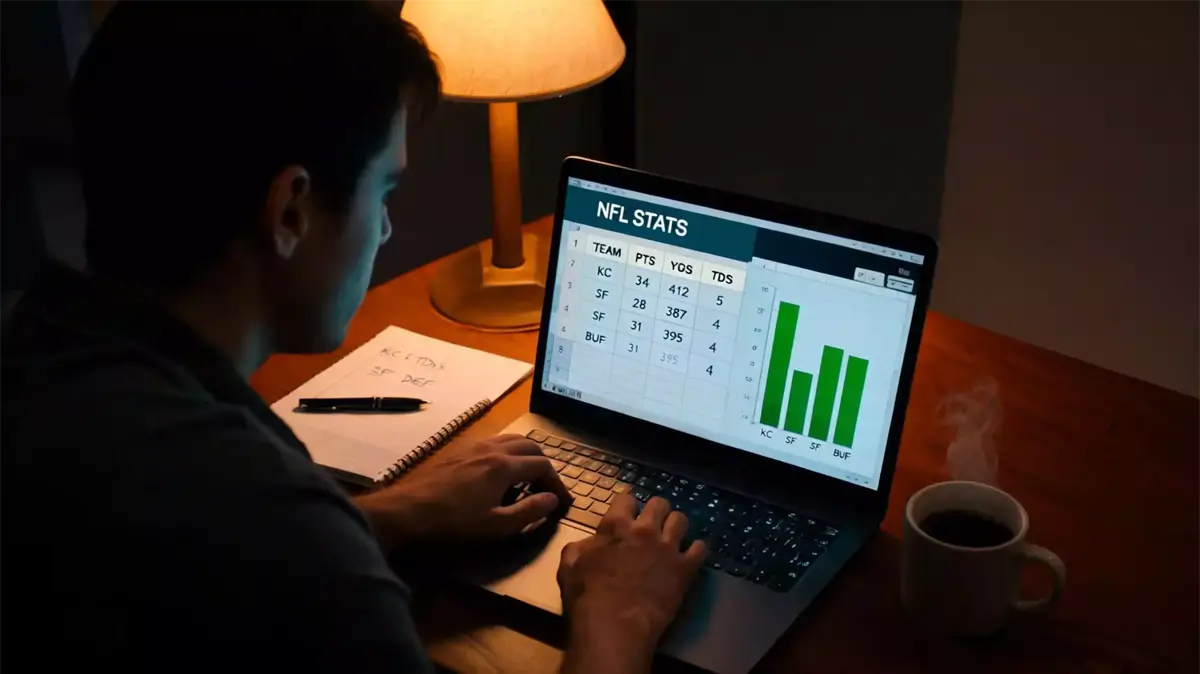
Step one is where the work starts, and it's where most punters cut corners. I'm looking for players who receive a high share of their team's red-zone opportunities — not just players who score a lot of touchdowns historically, but players who are consistently involved when the offence is inside the 20. There's a difference. A running back might have eight touchdowns through ten weeks, but if his team has started giving goal-line carries to a short-yardage specialist, his future TD rate will drop even if his recent numbers look strong. Volume is the signal; historical TDs are the noise.
Step two introduces the defence. In the 2025 season, only four defensive units managed to hold opponents below a 50% touchdown rate in the red zone — Denver, Minnesota, the LA Rams, and the LA Chargers. Every other defence in the league allowed touchdowns on more than half of red-zone possessions. That spread creates genuine matchup edges: a high-volume red-zone player facing a bottom-ten red-zone defence is a fundamentally different proposition than the same player facing Denver's front. The Eagles led the NFL with a 70.97% red-zone TD conversion rate through the 2025 season, which tells you their skill players had a structural scoring advantage week after week.
Steps three and four are about price, not prediction. I calculate implied probability (1 divided by decimal odds), compare it to the player's recent TD rate adjusted for matchup quality, and only proceed if the gap is meaningful — typically at least five percentage points. Line shopping across multiple bookmakers often reveals value that a single bookmaker's price would hide. One operator might price a player at 2.20 while another has him at 2.50, and that 0.30 difference can shift expected value from negative to positive.
Step five — sizing — is where discipline lives. I devote an entire section to bankroll management later, but the short version is this: no single TD prop gets more than 3% of my working bankroll, and most get 1-2%. Accumulators get even less. This isn't conservatism for its own sake; it's the mathematical recognition that even well-analysed TD props have variance baked into their DNA. A player with a 60% chance of scoring will fail to score 40% of the time. Over a season, proper sizing keeps you in the game long enough for the edge to compound. The complete TD betting strategy guide walks through each of these steps with extended worked examples and seasonal data.
A framework is only as good as the inputs that feed it — and the most impactful input for step two is understanding exactly where defences break down.
Matchup Analysis: Targeting Weak Defences
I keep a colour-coded spreadsheet that ranks every NFL defence by their red-zone TD rate allowed, updated each Wednesday morning during the season. The extremes are striking. In 2025, the gap between the best and worst red-zone defence was nearly 30 percentage points — meaning a skill player facing the league's softest defence had, all else being equal, a dramatically higher probability of scoring than the same player lined up against Denver's unit. That's not a marginal edge. That's a different market entirely.
Only four NFL defences in the entire 2025 season held opponents below a 50% touchdown conversion rate in the red zone: Denver at 42.6%, Minnesota at 42.9%, the LA Rams at 46.2%, and the LA Chargers at 46.9%. Every other team allowed touchdowns on more than half of red-zone trips. When your TD prop candidate faces one of the 28 defences outside that elite tier, the structural probability of scoring rises significantly.
The mistake I see most often is treating all weak defences as equally exploitable. A defence might allow a high overall TD rate but be specifically vulnerable against the run or the pass — and that distinction determines whether you want a running back prop or a wide receiver prop in that matchup. If a defence ranks bottom-five against rushing touchdowns but middle-of-the-pack against receiving TDs, the running back facing that unit has a clearer path to the end zone than the wide receiver in the same game. I cross-reference positional vulnerability with the player's role in their offence: a wide receiver who dominates red-zone targets matters most against defences that leak passing TDs in scoring territory.
Defensive personnel changes during the week add another layer. An injury to a starting linebacker can shift a defence's red-zone efficiency by several percentage points within a single game, and bookmaker lines don't always adjust quickly enough to reflect these changes. Checking the Thursday and Friday injury reports for confirmed absences in the opposing defensive front seven or secondary is a small investment of time with outsized returns on your matchup grading accuracy.
This section is deliberately overview-level. What I want you to take from here is the principle: not all defences are equal, and the quantifiable differences between them are large enough to shift a TD prop's expected value from negative to positive. Build the matchup check into your weekly workflow and you'll see the impact within a few weeks of disciplined tracking.
How Game Script Shapes Touchdown Opportunities
Picture two versions of the same game. In the first, the team you're betting on builds a three-score lead by half-time. In the second, they trail by two touchdowns entering the fourth quarter. The same players are on the field, the same offensive coordinator is calling plays, but the type of touchdowns scored — and who scores them — shifts dramatically between those two scenarios. That shift is game script, and ignoring it is like placing a weather-dependent bet without checking the forecast.
The pattern is well-documented and consistent across NFL seasons. Teams that trail lean heavily on the passing game to move the ball quickly, which creates more opportunities for wide receivers and tight ends to score through the air. Five of the seven touchdowns in the most recent Super Bowl were scored by wide receivers — a reflection of the pass-heavy approach that defines modern championship football and regular-season games where teams are chasing deficits. Teams that lead, conversely, lean on the running game to drain clock and protect advantages, funnelling touchdown opportunities toward running backs on goal-line carries.
Do
- Check Vegas point spreads before kickoff — a team favoured by seven or more points is likely to lead, increasing rushing TD opportunities for their backs
- Back wide receivers in games with high projected totals (over 48.5) where both teams are expected to score frequently through the air
- Factor in pace of play — up-tempo offences create more total possessions and therefore more TD chances for all positions
Don't
- Bet a running back's TD prop in a game where his team is a heavy underdog — trailing teams abandon the run early
- Ignore the total entirely — a projected low-scoring game (under 40.5) means fewer TDs for everyone, regardless of matchup quality
- Assume game script is fixed — live betting allows you to react to actual game flow rather than pre-game projections
The practical application is straightforward. Before kickoff, I check two numbers: the point spread and the total. The spread tells me which team is expected to lead and which is expected to trail, shaping the likely split between rushing and passing TDs. The total tells me the overall volume of expected scoring — a game projected at 52.5 total points offers more touchdown opportunities than one set at 38.5, full stop. These numbers aren't predictions with surgical precision, but they provide a directional framework that prevents you from backing a running back in a game where his team will probably be throwing the ball 45 times.
Game script also creates late-game volatility. Garbage time — the final minutes of a lopsided game — produces touchdowns that are statistically real but strategically meaningless. For anytime TD bettors, those garbage-time scores count, and they disproportionately benefit wide receivers on losing teams. It's an angle worth considering when a talented receiver's team is a significant underdog.
TD Scorer Accumulators and Same-Game Parlays
Let me be direct about something: accumulators are the most profitable product bookmakers offer — profitable for them, not for you. I say this as someone who still places TD accumulators regularly, because there's a difference between understanding the mathematics and avoiding the market entirely. The key is knowing exactly what you're accepting when you combine multiple TD legs into a single bet.
A standard TD accumulator — or acca, or parlay — multiplies the decimal odds of each leg together to produce a combined price. Three anytime TD selections at 2.00, 2.50, and 1.80 produce a combined return of 2.00 x 2.50 x 1.80 = 9.00. The appeal is obvious: a £10 stake returns £90 instead of the £23, £25, or £18 you'd get from three separate singles. The trap is equally obvious: all three must win for the bet to pay. If even one player fails to score, the entire accumulator loses.
Worked Example: Three-Leg TD Accumulator
Leg 1: Running back vs weak rush defence — 1.80 decimal (4/5 fractional). Implied probability: 55.6%.
Leg 2: Wide receiver with high red-zone targets — 2.50 decimal (3/2 fractional). Implied probability: 40.0%.
Leg 3: Tight end in favourable matchup — 3.00 decimal (2/1 fractional). Implied probability: 33.3%.
Combined odds: 1.80 x 2.50 x 3.00 = 13.50. Combined implied probability: 0.556 x 0.400 x 0.333 = 7.4%. This acca has roughly a one-in-fourteen chance of landing — but if it does, a £10 stake returns £135.
The combined probability of a three-leg TD accumulator is almost always lower than punters intuitively estimate. A three-leg acca where each individual leg has a roughly 50% chance of hitting still only lands about 12.5% of the time. The bookmaker margin compounds across legs, so the actual edge against you is larger in an accumulator than in any single bet. Treat accas as entertainment with controlled stakes, not as a core strategy.
Same-game parlays — where all legs come from a single match — introduce correlation. If you back a running back to score and also back the "over" on total points, those outcomes are positively correlated, and bookmakers adjust SGP pricing downward accordingly. The margin inside an SGP is typically larger than in a standard cross-game accumulator. Across 24 of the last 35 Super Bowls, a touchdown was scored from one yard or closer — illustrating how concentrated scoring patterns can be, and how SGP legs built around goal-line situations tend to correlate in ways the pricing may not fully capture.
My personal rule: accumulators get no more than 10% of my total weekly TD betting stake, and no single acca exceeds three legs. Beyond three legs, the compounding probability drop makes the bet nearly impossible to justify on expected value grounds, regardless of how strong each individual selection looks in isolation.
UK Bookmakers for NFL Touchdown Betting: A Quick Comparison
When I started betting NFL props in the UK, the choice of bookmaker felt irrelevant — they all offered touchdowns, they all had apps, what was the difference? After nine years of logging every bet and tracking where I consistently got better or worse prices, I can tell you the difference is substantial. Not every UK bookmaker treats the NFL TD market with the same depth or pricing sharpness, and which operators you use directly affects your bottom line.
The UK online betting sector generated £7.8 billion in gross gambling yield for the year ending March 2025, growing 13.1% year on year. That's a competitive market, and competition benefits punters — but only if you actively leverage it. With 10% of UK adults betting on sport online, the major operators all cover NFL, but their coverage varies significantly when you drill into touchdown props specifically.
The criteria that matter for TD betting are narrower than for general football or horse racing. You want market depth — does the bookmaker offer anytime TD, first TD, last TD, and 2+ TD markets, or just the basics? You want early line availability — bookmakers that post TD odds by Tuesday or Wednesday give you first access to prices before they sharpen. You want same-game parlay functionality for TD combinations. And you want competitive pricing on the specific odds ranges where TD props sit (typically 1.50-5.00 decimal), because a small edge in pricing compounds over hundreds of bets across a season.
Market Depth
Not all operators offer the full range of TD prop types. Check for anytime, first, last, and 2+ TD markets before committing.
Early Lines
Bookmakers that release NFL TD odds midweek give you a pricing advantage. Lines tighten as kickoff approaches.
SGP Builders
Same-game parlay tools vary widely in NFL support. Some restrict TD legs, others build them seamlessly.
Cash Out
Mid-game cash out on TD props isn't universal. If you value the option to lock in profit or cut losses, confirm availability.
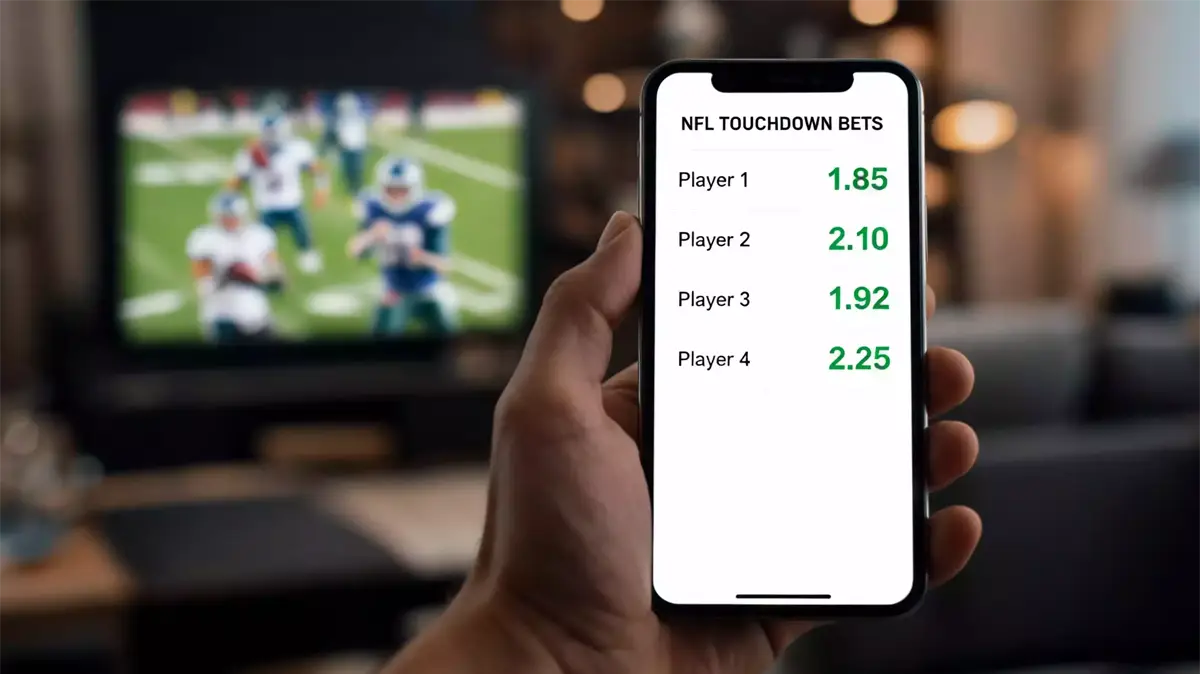
I run accounts across multiple UK-licensed operators, and I place each bet wherever the odds are strongest for that specific selection. The difference between 2.30 and 2.50 on the same player's anytime TD prop might look small, but over a season of 150-200 TD bets, that average odds improvement translates to measurable profit. The detailed comparison of UK bookmakers for NFL touchdown betting breaks down each major operator's strengths and limitations across every criterion that matters for TD props.
Bankroll Management for Touchdown Props
Every losing stretch I've had in nine years of TD betting can be traced to the same root cause: staking too much on a single bet or a single week because I was "sure" about a selection. Conviction is fine. Oversizing because of conviction is how punters blow through their bankroll before the edge has time to materialise. TD props carry inherent variance — even well-selected bets lose regularly — and your staking strategy needs to account for that reality from the start.
A widely-used guideline among professional prop bettors is to stake between 1% and 3% of your total bankroll on any single bet. For a £500 bankroll, that means £5 to £15 per TD prop. This range protects against inevitable losing runs while allowing your bankroll to grow when your edge plays out over hundreds of bets.
The distinction between singles and accumulators matters for sizing. A single anytime TD bet at 2.00 has roughly a 50% chance of winning — you'll see regular returns interspersed with losses, and the variance is manageable. A three-leg accumulator at 9.00 has roughly an 11% chance of winning — you'll lose the vast majority of these bets, and the wins, when they arrive, need to be large enough to compensate for the losing streaks between them. For this reason, I stake accumulators at a fraction of what I'd put on a single: typically 0.5-1% of bankroll versus 1-3% for individual TD props.
The average American NFL bettor stakes approximately $335 (roughly £265) across an entire season. That's a useful benchmark for recreational participation, but it's not a bankroll management strategy. A strategy requires a fixed starting bankroll, a per-bet staking rule, and the discipline to follow both regardless of how the previous week went. I track every bet in a spreadsheet with the date, player, odds, stake, and result. At the end of each month, I review whether my staking has drifted above 3% on any individual bet — and if it has, I recalibrate immediately.
Do
- Set a fixed seasonal bankroll before the NFL season starts and never add to it mid-season
- Stake 1-3% per single TD prop, 0.5-1% per accumulator
- Track every bet and review your staking discipline monthly
Don't
- Chase losses by increasing stakes after a bad week — variance is normal, not a signal to bet more
- Treat accumulator wins as "free money" to reinvest aggressively — bank the profit and maintain your unit size
- Stake a percentage of your remaining bankroll that increases as the bankroll shrinks — use a fixed unit based on your starting amount
Bankroll management isn't glamorous. But it's the factor that separates punters who survive a full season from those who're re-depositing by Week 8. The edge in TD betting is real but thin, and it only compounds if you're still in the game to capture it.
The NFL's Explosive Growth in the UK
I attended my first London Game in 2018, and the upper tiers were half-empty. Fast forward to 2025, and more than six million people in the UK watched London Games on television or online across the season. The NFL in Britain isn't a curiosity anymore — it's a genuine sporting presence, and the betting market is evolving to match.
The viewership numbers tell the story. The UK audience for Super Bowl LX reached 5.2 million — a record that keeps getting broken every February. Even more striking is the demographic shift: viewership among under-35s surged 91% year on year around Super Bowl LVIII. Henry Hodgson, the NFL's general manager in the UK, noted that the figures reflect the growth of the sport "particularly among the youth demographic" the league has targeted. Bryan Henderson at Sky Sports called the numbers "testament to the continual growth of the NFL in the UK."
The roots go deeper than television. The NFL has invested heavily in grassroots participation, with 250,000 children now playing flag football in UK schools — a number that has doubled every year for the past three to four years. Hodgson has spoken extensively about London's central role in the NFL's international strategy, calling it the hub around which global growth is anchored. That grassroots pipeline is creating a generation of fans who understand the sport at a tactical level, not just as spectacle — and those are exactly the fans who graduate into prop betting markets like touchdown scorers.
A quarter of a million children in the UK are now playing flag football through school programmes — with participation doubling annually. That pipeline of young fans who understand NFL strategy, not just the spectacle, is building the future audience for sophisticated NFL betting markets including TD props.
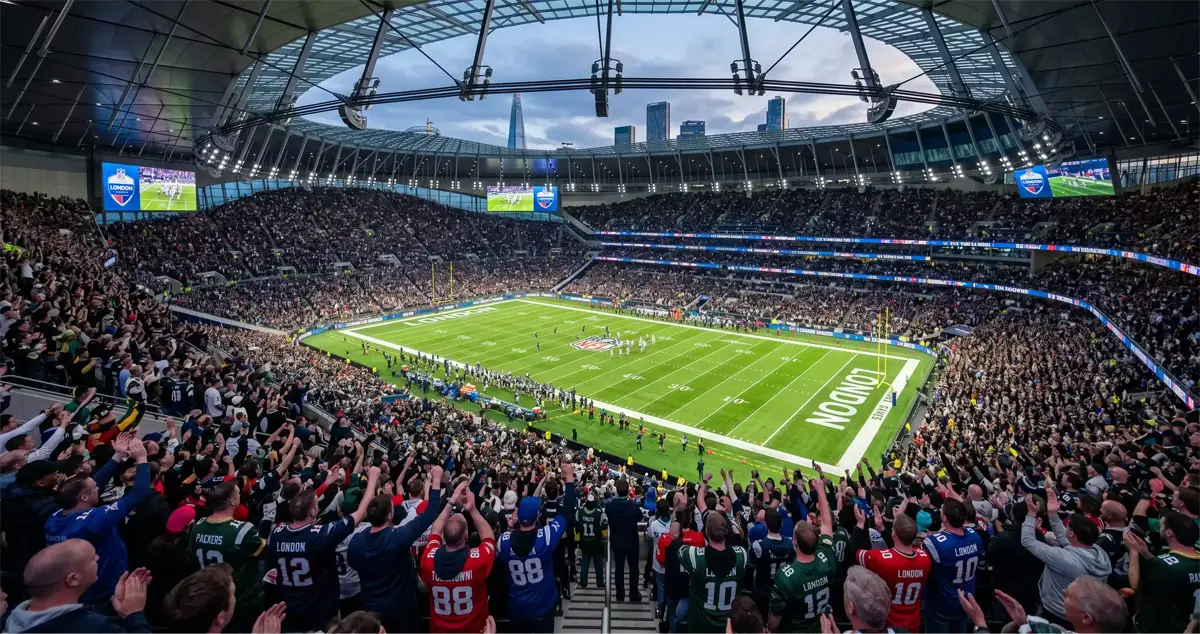
For punters, the growth matters because it drives bookmaker investment. As UK demand rises, operators respond with deeper prop markets, earlier line postings, and more competitive TD odds. Five years ago, finding an anytime TD market on a mid-season non-primetime game required checking multiple sites. Today, coverage approaches Premier League levels. Sky Sports peak NFL viewership hit 761,000 in a single broadcast window — a 35% jump over the previous record — and those eyeballs translate directly into betting volume that bookmakers want to capture.
Common Mistakes UK Punters Make with TD Bets
The most expensive lesson I've learned in nearly a decade of TD betting didn't come from a bad pick — it came from a good one that I staked badly. But that's a bankroll story. The mistakes that cost most UK punters the most money are subtler and more systematic than any single blown bet. Here are the patterns I see most often, each one backed by data or direct experience.
The first and most common mistake is betting on names instead of numbers. A star running back who leads the league in rushing yards seems like an obvious TD pick, right? Not necessarily. In the 2025 season, the league's leading rusher accumulated 1,621 rushing yards but failed to score a touchdown in eight of his seventeen games. Bettors who backed him at short odds every week based on name recognition absorbed significant losses, because his high yardage didn't translate to proportional goal-line usage. His team used a different back in short-yardage situations, and that information was freely available to anyone who checked the red-zone data instead of the highlight reel.
The second mistake is ignoring implied probability entirely. A player priced at 1.50 to score anytime carries a 66.7% implied probability — meaning the bookmaker expects him to score in roughly two out of every three games. If his actual scoring rate over a meaningful sample is 55%, you're paying a premium for a name. Most UK punters never make this calculation, which means they routinely accept prices that are worse than fair value. The five-second habit of dividing one by the decimal odds would prevent this error on its own.
Third: overloading accumulators. The temptation to stack five or six TD legs into a massive acca is strong, especially on a full Sunday slate. But a six-leg accumulator where each leg has a 50% chance of winning lands just 1.6% of the time — once in every sixty-three attempts, on average. The bookmaker margin compounds across each leg, making the expected value progressively worse with each addition. Three legs is my ceiling.
Fourth: placing every bet with a single bookmaker. The same player's anytime TD prop can vary by 0.20-0.50 in decimal odds across UK operators, and the punter who consistently takes the best available price gains a cumulative edge that the single-operator bettor simply cannot access.
Do
- Check red-zone usage and goal-line carry share before every bet, regardless of the player's reputation
- Calculate implied probability and compare it to the player's actual TD rate
- Limit accumulators to three legs and size them at 0.5-1% of bankroll
- Compare prices across at least three UK bookmakers before confirming
Don't
- Back a player because he's a household name — data decides, not fame
- Accept the first price you see without checking competitors
- Stack five or more TD legs into a single accumulator and call it strategy
- Ignore the defensive matchup because the offensive player "always scores"
Frequently Asked Questions About NFL TD Bets
What is an anytime touchdown scorer bet and how does it work?
An anytime touchdown scorer bet is a wager on a named player to score at least one touchdown during a game by any method — rushing, receiving, fumble recovery, interception return, or kick/punt return. The bet settles as a winner the moment the player crosses the goal line, regardless of when in the game it happens. Overtime counts. It's the most popular touchdown prop in UK betting markets.
Do passing touchdowns count for touchdown scorer bets?
No. When a quarterback throws a touchdown pass, the scorer is the player who catches the ball — not the quarterback. A QB can only win a touchdown scorer bet by rushing for a touchdown or catching a pass on a trick play. This rule applies universally across UK bookmakers and is the single most common source of confusion for first-time NFL bettors.
Does overtime count for anytime touchdown scorer bets?
Yes. All major UK-licensed bookmakers include overtime in anytime TD scorer settlement. If your player scores only in overtime, the bet pays out as a winner. This is one reason the anytime TD market is more forgiving than first TD scorer bets, where overtime is irrelevant because the first touchdown has already occurred.
What is the difference between first touchdown scorer and anytime touchdown scorer?
First touchdown scorer requires your player to score the very first touchdown of the entire game. Anytime touchdown scorer requires your player to score at any point. First TD bets carry higher odds (typically 8.00-20.00 decimal) because predicting the first scorer is harder. Anytime TD bets sit at 1.50-5.00 decimal with higher win rates and more analysable edges for systematic betting.
Can you parlay multiple anytime touchdown scorer bets?
Yes. You can combine multiple TD selections into an accumulator across different games or within the same game via a same-game parlay. The combined odds multiply, creating higher returns but substantially lower win probability. A three-leg TD acca where each leg has a 50% win probability only lands about 12.5% of the time. SGP availability for TD props varies by UK operator.
What happens if my touchdown scorer pick gets injured during the game?
If your player takes at least one snap but leaves injured without scoring, the bet is typically settled as a loss. If the player is ruled out before the game and never takes the field, most UK bookmakers void the bet and return your stake. The critical distinction is whether the player was "active" for the game — check your bookmaker's specific settlement rules, as policies differ on edge cases.
Which UK bookmakers offer the best NFL touchdown scorer odds?
No single bookmaker consistently offers the best odds across all TD selections. Pricing varies game to game, which is why maintaining accounts with three or four UK-licensed operators and placing each bet at the strongest available price is essential. Some bookmakers post odds earlier in the week; others offer better SGP builders or cash-out options on TD props.
Your Edge Lives in the Process, Not the Picks
If there's a single thread running through everything here, it's this: the advantage in NFL TD betting doesn't come from knowing which player will score on a given Sunday. It comes from having a process that identifies favourable situations more often than unfavourable ones, and from the discipline to bet those situations at the right size and the right price. Red-zone usage, defensive matchup grading, implied probability calculations, line shopping, bankroll management — none of these is complicated on its own. Together, they form a system that compounds small edges into measurable results over the course of a season.
The legal, regulated sports betting landscape gives UK punters more tools and more protection than ever before. Bill Miller, the president of the American Gaming Association, captured it well when he described how legal sports betting "enhances the fun and friendly competition" that make the NFL special — while emphasising that every bettor should have a plan before placing a wager. That plan, for TD props, starts with data and ends with discipline. The punters who treat touchdown betting as an analytical exercise, not a guessing game, are the ones who come out ahead when the season wraps.
I've spent nine years refining this approach, and I'm still learning. New data sources emerge, bookmaker markets evolve, and the NFL itself changes — more pass-heavy offences, more mobile quarterbacks, more red-zone creativity. What doesn't change is the underlying principle: the numbers are there, the tools are accessible, and the UK betting market is deep enough to reward punters who do the work. Start with one concept from this guide — implied probability, red-zone usage, whatever resonates most — and build from there. The edge isn't a secret. It's a habit.
Related posts
NFL Playoff Touchdown Props: How Postseason Football Changes the TD Equation
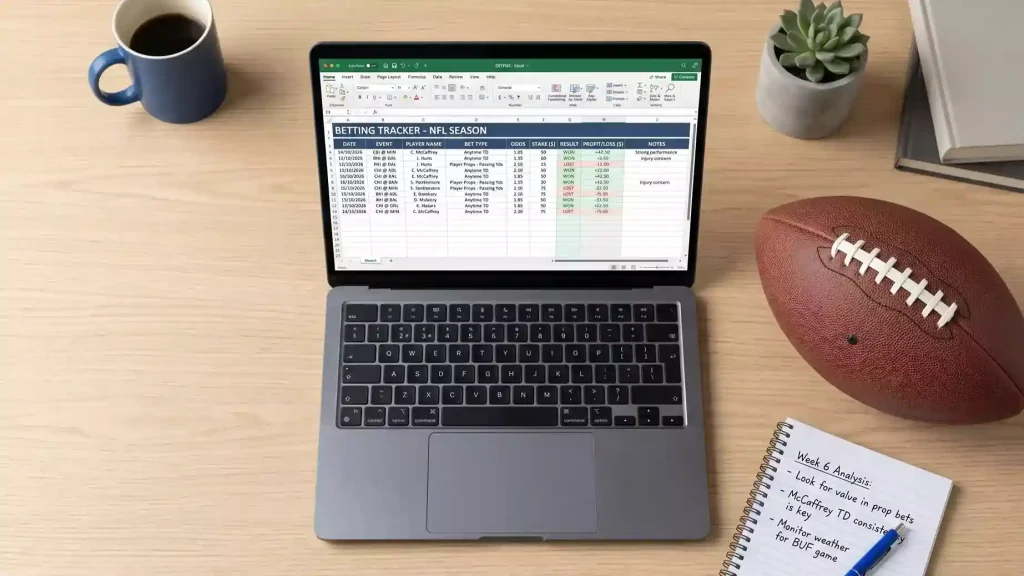
NFL TD Prop Record Keeping: How to Track Your Bets and Measure Your Edge