Anytime TD Scorer Parlays: Optimal Accumulator Construction
 Available in US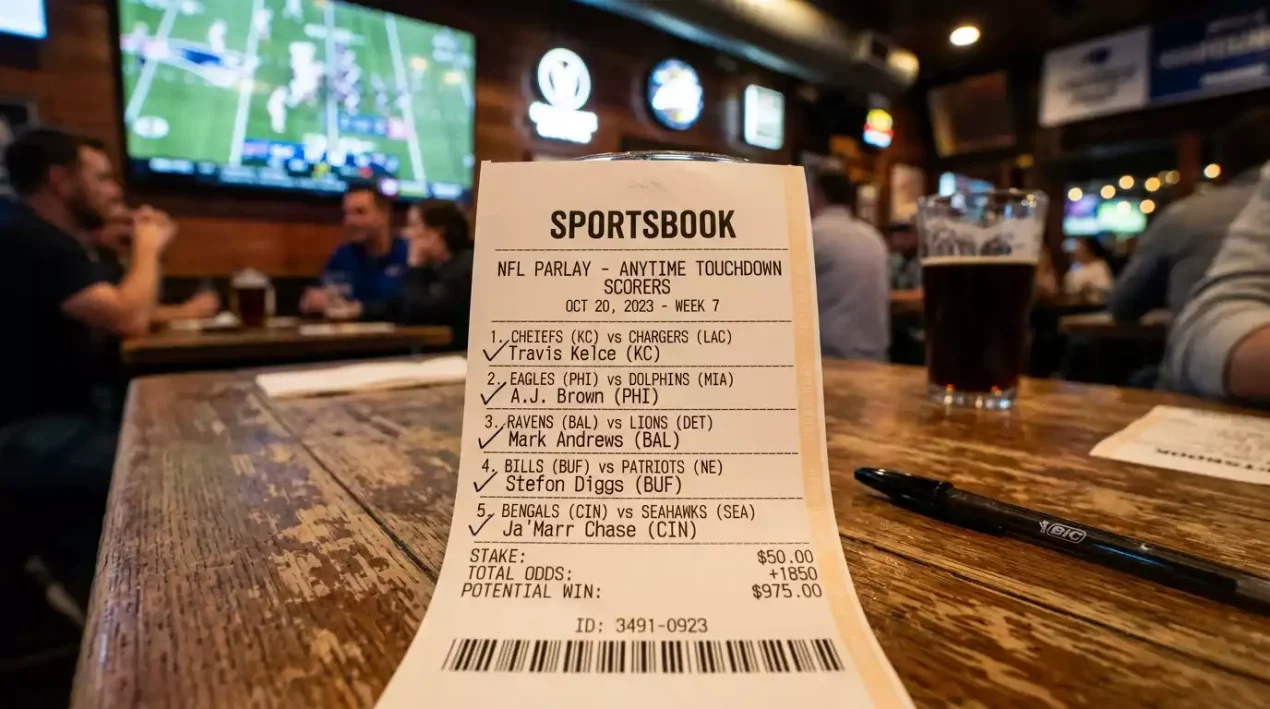
If you prefer combining events from a single matchup, understanding the mechanics of a same-game touchdown parlay is essential.
Optimal Leg Counts for Touchdown Accumulators
I used to think bigger was better. Five legs, six legs, sometimes seven. The payouts looked spectacular on paper. Then I sat down with a spreadsheet and calculated what those accumulators actually needed to hit rate-wise to be profitable over a full season. The answer sobered me up fast.
Here’s the reality. If you’re selecting players who each have roughly a 50% implied probability of scoring (around 2.00 decimal odds), a two-leg accumulator needs both to hit — that’s a 25% chance. Manageable. A three-leg accumulator drops to 12.5%. A four-leg drops to 6.25%. By the time you hit five legs, you’re looking at just over a 3% probability even if every individual pick is a coin flip. The payout scales up, but the hit rate craters.
My sweet spot, after years of tracking results, is two to three legs. Two-leg accumulators give you a meaningful payout uplift — roughly double what you’d earn from a single — while keeping the probability in a range where your edge can actually express itself over a meaningful sample. Three legs are the ceiling for anyone who takes this seriously. Beyond three, you’re not betting — you’re buying a lottery ticket with extra steps.
That doesn’t mean three-leg accumulators are easy. Two thirds of Super Bowls in history have featured a touchdown scored from one yard or closer, but even a high-probability individual pick like a short-yardage specialist can miss on any given Sunday. When three of those picks need to land simultaneously, variance dominates. Keep the leg count low, and let the individual selection quality do the heavy lifting.
Correlation Risk: When Legs Work Against Each Other
Early in my accumulator experiments, I built what I thought was a clever three-legger: the WR1 on Team A, the RB1 on Team A, and the WR1 on Team B — all from the same game. It seemed logical. High-scoring game, lots of touchdowns to go around. What I didn’t account for was the correlation problem.
Correlation, in this context, means that the outcome of one leg isn’t independent of the others. When Team A’s WR1 scores, it often means Team A is passing effectively in the red zone. That’s great for the WR1 — but it also means Team A might be leading, which shifts the game script away from Team B’s passing attack and reduces the chance that Team B’s WR1 scores. My three legs weren’t three independent events. They were tangled together by game flow, and that entanglement was working against me.
The safest approach for standard accumulators is to select players from different games entirely. When your picks come from separate contests, the outcomes are genuinely independent. One game’s flow has no bearing on another. This removes correlation risk completely and lets your edge on each individual pick compound cleanly.
If you do want to combine players from the same game — and there are reasons to do so, particularly when you expect a high-scoring affair — be deliberate about it. Pair a running back from one team with a wide receiver from the other. That way, the game script that benefits one pick (a team trailing and passing more) also benefits the other (the opposing team running to protect a lead). Think about how the game is likely to flow and build legs that benefit from the same narrative rather than conflicting ones. For more on structuring same-game parlay TD bets, the mechanics of how bookmakers handle correlated outcomes add another layer to consider.
Staking Strategy for TD Accumulators
This is where most punters get it backwards. They size their accumulator stakes the same way they size their singles — or worse, they increase the stake because the potential payout is so large. That’s a recipe for bankroll destruction.
Accumulators should be staked significantly smaller than singles. My rule is straightforward: if my standard single-bet unit is 1-2% of bankroll, my accumulator unit is 0.25-0.5%. A two-leg accumulator gets half a unit. A three-leg accumulator gets a quarter unit. The potential return is already amplified by the accumulator structure, so there’s no need to amplify it further with oversized stakes.
The reasoning is mathematical. Accumulators have higher variance than singles by definition. A single TD prop with a 50% hit rate will produce roughly even numbers of wins and losses over a 20-bet sample. A three-leg accumulator with the same individual win rates will produce a winning ticket roughly once every eight attempts. That means you need to survive seven consecutive losses between each win. If your stake is too large relative to your bankroll, those seven losses will do serious damage before the eighth attempt pays off.
I also recommend capping the total percentage of your weekly bankroll allocated to accumulators. No more than 5% of your bankroll should be in accumulator action on any given week. If your unit for accumulators is 0.5%, that means a maximum of ten accumulator bets per week. In practice, I rarely place more than three or four, because the selection criteria for each leg should be stringent enough that opportunities don’t come in bulk.
When the Maths Says Walk Away
The hardest discipline in accumulator betting is knowing when not to place one. Some weeks I’ll have two strong individual TD picks but no third that meets my criteria. The temptation is to add a mediocre third leg just to get the three-leg payout. Every time I’ve done that, I’ve regretted it. A weak link doesn’t just reduce your probability of winning — it contaminates the entire structure.
Maximize your accumulator returns with expert advice from the leading NFL TD betting experts.
If you only have two quality picks, place a two-leg accumulator and be content with the smaller payout. If you only have one, place a single. The accumulator is a tool for combining genuinely strong selections, not a format you need to fill every week. The most profitable stretches in my accumulator record have been the weeks where I placed fewer bets, not more. Quality of selection will always outperform quantity of legs, and the moment you start forcing picks to reach a target leg count, you’ve shifted from analysis to gambling.
Should I mix favourites and longshots in a TD accumulator?
Mixing one or two short-priced favourites with a single longer-odds selection can work well. The favourites provide a higher base probability of hitting, while the longshot adds meaningful payout uplift. Avoid building accumulators entirely from longshots — the combined probability becomes too low to sustain over a season, even if the payouts look attractive on paper.
How does correlation between parlay legs reduce actual probability?
When two legs are correlated — for example, two players from the same game whose scoring chances are influenced by the same game script — the combined probability isn’t simply the product of their individual probabilities. Positive correlation (both benefit from the same game flow) inflates the true joint probability above the independent calculation, while negative correlation (one scoring reduces the other’s chances) deflates it. Bookmakers adjust for this in same-game parlays, typically by reducing the combined payout.
This material was created by the Endzone Edge team.
Related posts

NFL Playoff Touchdown Props: How Postseason Football Changes the TD Equation
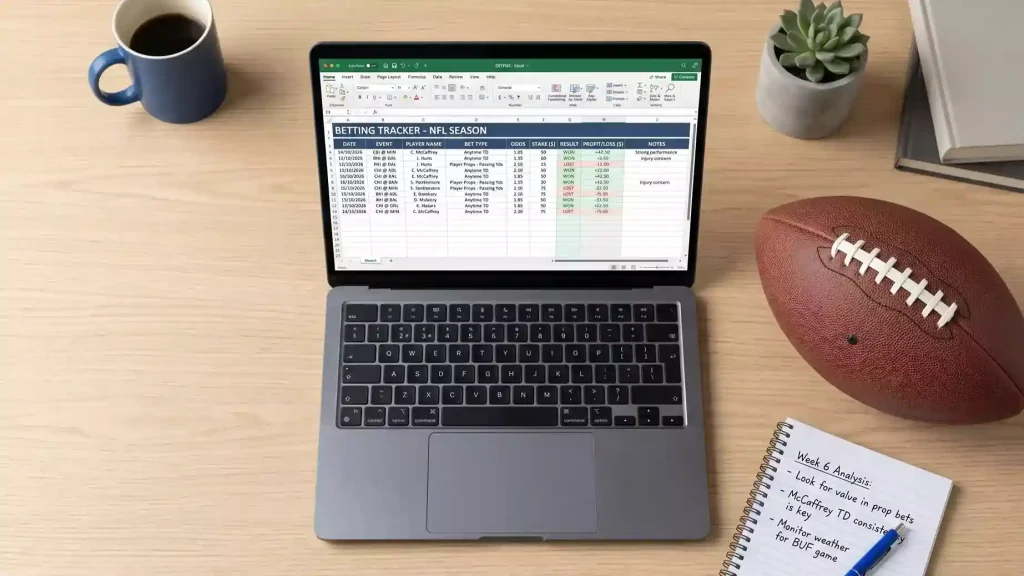
NFL TD Prop Record Keeping: How to Track Your Bets and Measure Your Edge