NFL TD Betting Mistakes: Traps Every Punter Must Avoid
 Available in US
Betting on Player Names vs Raw Statistics
This is the mistake that costs UK punters more money than any other in the TD prop market. A player has a famous name, an impressive highlight reel, and strong fantasy football numbers, so he must be a good touchdown bet. The logic feels airtight until you examine the data.
The 2025 season provided the perfect case study. Dalvin Cook led the NFL in rushing with 1,621 yards — an elite campaign by any measure. But his anytime TD prop was one of the biggest money losers for bettors at major sportsbooks. The reason? He went eight games out of seventeen without scoring a single touchdown. His yardage production was outstanding, but he wasn’t the primary goal-line option on his team, and game script frequently pulled him off the field in short-yardage situations. Punters saw 1,621 rushing yards and backed him reflexively. The data — specifically his goal-line carry share — told a different story.
The fix is mechanical: before placing any TD prop, check goal-line usage, red-zone snap share, and recent scoring history. A player’s name should be the last thing you look at, not the first. Some of the best TD bets I’ve placed have been on players I barely recognised before checking their red-zone numbers.
Ignoring the Defensive Matchup
I spent my first two seasons analysing only the offensive player. His stats, his role, his volume. I treated the defence as background noise — a vague sense that some defences were “good” and others were “bad,” without ever quantifying what that meant for TD props specifically.
The numbers changed my approach entirely. During the 2025 season, only four defences held opponents below a 50% touchdown rate in the red zone: Denver, Minnesota, the LA Rams, and the LA Chargers. Every other defence gave up touchdowns on at least half their red-zone possessions. That variation is enormous, and it directly affects the probability of any individual player scoring. A strong TD candidate facing Denver’s 42.6% red-zone defence is a fundamentally different bet than the same player facing a defence allowing touchdowns on 65% of red-zone trips. Building a systematic TD betting strategy starts with treating the matchup as an equal partner to the player analysis, not an afterthought.
Overloading Accumulators With TD Legs
UK betting culture loves an accumulator. The dream of turning a small stake into a large payout is baked into how we think about betting. But loading an acca with five or six TD scorer legs is one of the most reliable ways to destroy value that I’ve encountered.
The problem is compounding probability. Even if every individual leg has a 55% chance of hitting — which is optimistic for any TD prop — a five-leg accumulator has only a 5% chance of landing. You need to hit this once in twenty attempts just to break even, assuming the payout compensates for the probability, which bookmaker margins ensure it often doesn’t. Three legs is the ceiling for anyone serious about long-term profitability. Beyond that, the variance overwhelms any analytical edge you might have on individual selections.
The emotional pull of big accumulators is real. Placing a six-leg TD acca feels exciting in a way that two careful singles never will. But excitement isn’t edge. If your goal is entertainment, load up the acca. If your goal is sustainable profit, keep the leg count low and let the quality of each individual pick carry the weight.
Skipping Line Shopping Across Bookmakers
This is the laziest mistake and the easiest to fix. Different UK bookmakers price the same TD prop at different odds, and the differences aren’t trivial. I’ve seen the same player’s anytime TD prop range from 2.10 at one bookmaker to 2.40 at another on the same day. Over a season of fifty TD bets, consistently taking 2.40 instead of 2.10 adds up to a meaningful difference in your bottom line.
Line shopping takes five minutes. Open three or four bookmaker apps, compare the price on your selected player, and place the bet where the odds are best. That’s it. No special tools required, no advanced mathematics. Just the discipline to check multiple prices before committing your money. Five minutes of effort for a structural improvement in your expected returns — there isn’t a more efficient use of time in all of sports betting.
Chasing Losses With Larger Stakes
After a losing week I used to double my stakes on the following week’s TD bets. The reasoning felt logical at the time — I was “due” a winner, and the larger stake would recover my losses faster. That reasoning is a textbook example of the gambler’s fallacy, and it nearly emptied my prop-betting bankroll in my third season.
TD props have an inherent losing-streak frequency that’s higher than many punters expect. A bettor with a genuine 52% long-term hit rate will experience losing runs of six or seven bets multiple times per season. If you double your stakes during those runs, you amplify the damage during the period when your bankroll is already under stress. The correct response to a losing streak is the opposite: maintain your standard unit size, trust the process, and let the probability distribution revert. The maths hasn’t changed just because you’ve been on the wrong end of variance.
Neglecting Implied Probability Entirely
This might be the most common analytical gap among UK punters who bet on NFL TD props. They look at the odds, think “that feels about right,” and place the bet. The idea of converting those odds into an implied probability and comparing it to a baseline historical rate never crosses their mind.
The check takes thirty seconds. Divide 1 by the decimal odds and you have the implied probability. Compare that to the player’s actual TD rate over his last eight games. If the implied probability is lower than the historical rate, the bet has potential value. If it’s higher, the bookmaker is charging you more than the data justifies. This single step filters out a massive proportion of bad bets before they ever reach your betting slip.
Learn how the professionals operate by following the best NFL touchdown betting site in the UK.
What These Mistakes Have in Common
Every mistake on this list shares a root cause: substituting instinct for process. Betting on names feels right. Skipping line shopping feels convenient. Loading accumulators feels exciting. Chasing losses feels necessary. None of these feelings correlate with profitability. The punters who make money over a full NFL season are the ones who’ve built a repeatable process and have the discipline to follow it even when it feels boring, slow, or overly cautious. The edge isn’t in the picks — it’s in the process.
What is the most common mistake punters make with TD props?
Betting on famous names without checking their actual goal-line usage data. A player can be outstanding at gaining yards and still be a poor TD bet if he doesn’t handle short-yardage or goal-line carries. Checking carries inside the five-yard line and red-zone target share takes two minutes and eliminates the most common source of bad TD picks.
How do I avoid betting on overvalued touchdown favourites?
Calculate the implied probability from the offered odds and compare it to the player’s actual touchdown rate over his last six to eight games. If the bookmaker’s implied probability exceeds the player’s real scoring frequency, the price is too high. This check is especially important for star players whose odds are shortened by public money rather than by data.
This material was created by the Endzone Edge team.
Related posts
NFL Playoff Touchdown Props: How Postseason Football Changes the TD Equation
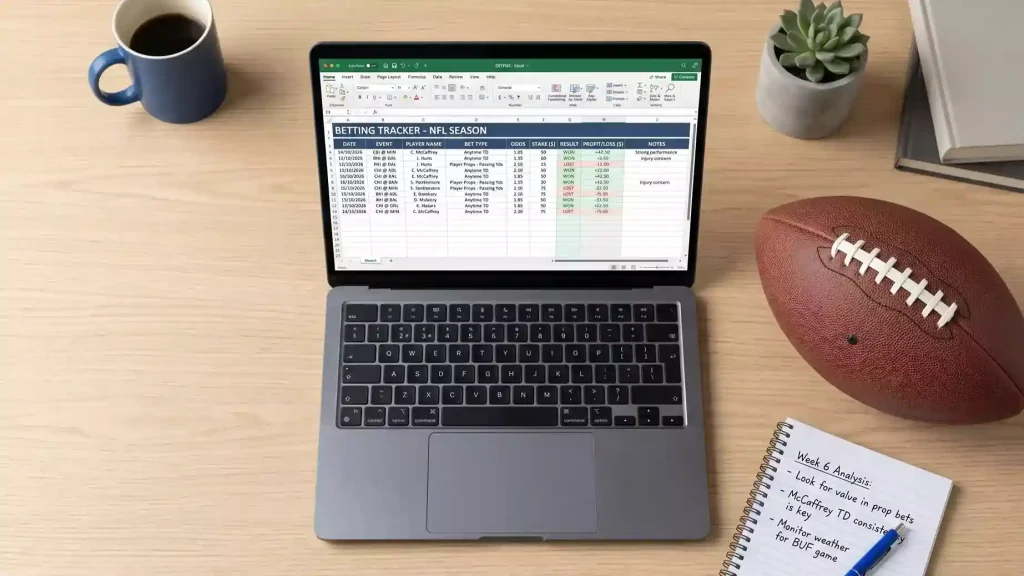
NFL TD Prop Record Keeping: How to Track Your Bets and Measure Your Edge