NFL Season Touchdown Leader Odds: How to Approach TD Futures Markets
 Available in US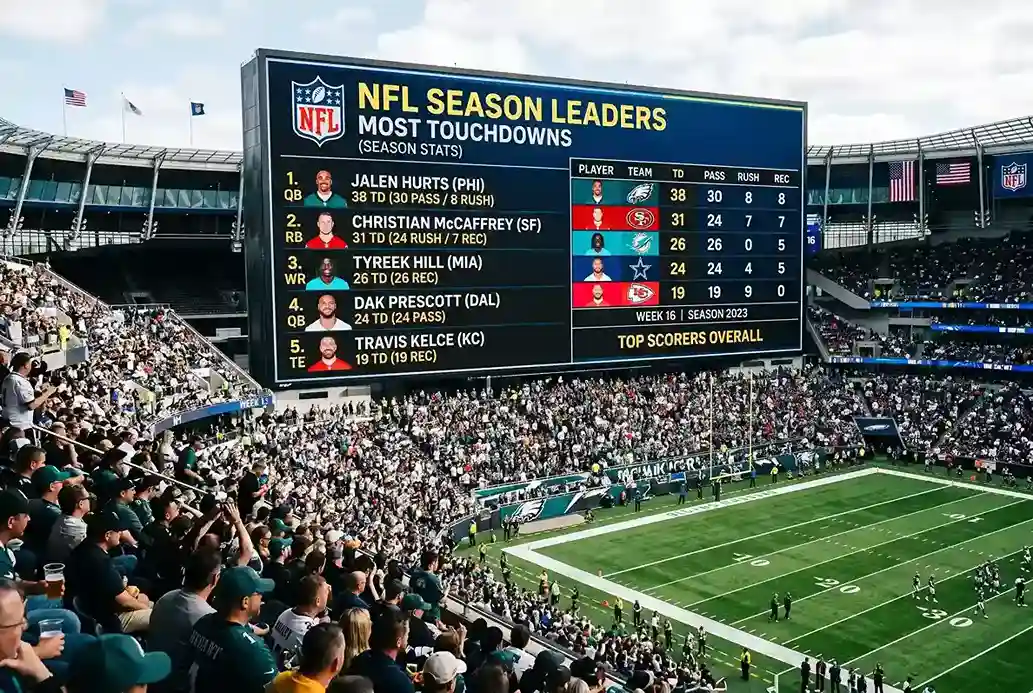
Every September I place one or two season-long touchdown leader futures. It’s the only market where I’m willing to lock my money up for five months, and it’s one of the most satisfying bets to track week by week as the numbers accumulate. Americans wagered $30 billion on the NFL in the 2025 season alone — an 8.5% increase year over year — and a slice of that handle goes into futures markets where patient bettors can find prices that won’t exist once the season is underway. As Bill Miller, the AGA’s president, put it, fans have more ways than ever to engage with the game they love, and TD leader futures are one of the quieter but more rewarding ways to do exactly that.
Types of Season TD Leader Markets
UK bookmakers typically offer three variants of the season TD leader market, and understanding the differences is essential because each carries distinct dynamics.
The total touchdown leader market covers all touchdowns regardless of type — rushing and receiving combined. This is the broadest market and the one most commonly available at UK operators. Running backs with heavy goal-line usage tend to dominate this category because they accumulate rushing TDs at a pace that most receivers can’t match through receiving TDs alone.
The rushing touchdown leader market isolates ground scores. This is historically the most predictable variant because rushing TDs concentrate heavily among bellcow backs. Jonathan Taylor led the league with 18 rushing touchdowns in 2025, and his profile — undisputed lead back on a competent offence with a dominant goal-line role — is the archetype that wins this market year after year. The receiving touchdown leader market is the most volatile of the three, because receiving TDs distribute more evenly across multiple receivers and are more sensitive to scheme, injury, and game script variance than rushing TDs.
When choosing which market to bet, consider your risk appetite. Rushing TD leader is the most researchable and least volatile. Total TD leader adds the complexity of comparing runners and receivers against each other. Receiving TD leader is the wild card — higher odds, but harder to predict with confidence over a full season.
Historical TD Leaders and What They Had in Common
I’ve gone back through ten seasons of TD leader results, and the winning profiles share a remarkably consistent set of traits. Understanding these traits doesn’t guarantee you’ll pick the winner, but it does eliminate a large portion of the field before you even look at the odds.
For total and rushing TD leaders, the winning player almost always had three things: a bellcow role with 65%+ of his team’s carries, a team that ranked in the top twelve in red-zone possessions per game, and health across at least fifteen of seventeen games. The health factor is the great equaliser — a player who misses two or three games can’t overcome the scoring gap even if his per-game rate is the highest in the league. Taylor’s 18-TD campaign in 2025 checked all three boxes: dominant role, productive offence, and a full seventeen-game slate.
For receiving TD leaders, the profile is slightly different. The winner tends to be the clear number-one target on a pass-heavy offence whose quarterback has a strong red-zone passer rating. Volume of red-zone targets matters more than total receiving yards. Davante Adams’ 12 red-zone receiving touchdowns in 2025 came from being the primary end-zone target on every possession inside the twenty — his overall yardage total was secondary to his goal-line role in the passing game. When evaluating running back TD prop candidates, many of the same volume-based principles apply on a game-by-game basis.
When to Place TD Futures for Best Value
Timing is the single biggest factor in futures value. The price you get in July is fundamentally different from the price available in October, and the difference isn’t just a matter of odds movement — it reflects a structural shift in the market’s information base.
Pre-season prices carry the most uncertainty and, consequently, offer the longest odds. A back priced at 12.00 in August might shorten to 5.00 by Week 6 if he starts the season scoring at a prolific rate. The August bettor locks in 12.00 and watches the value grow. The October bettor gets 5.00 for the same player with less uncertainty but far less upside.
My approach is to place half my futures allocation in the pre-season window (August through Week 1) and hold the other half until Weeks 4-6. The pre-season bet is the high-value, high-risk play based on offseason analysis of role changes, coaching hires, and depth chart shifts. The in-season bet is the confirmation play — by Week 4, you have enough data to identify which pre-season projections are materialising and which players are emerging as realistic contenders who weren’t on the radar in August.
One timing trap to avoid: don’t place futures after a player has a monster game that grabs headlines. Bookmakers react to public interest, and a three-TD performance in Week 3 will shorten a player’s season odds within hours, often beyond fair value. If you liked the player before the big game, you should have bet him before the big game. Chasing post-breakout prices is a reliable way to overpay.
Managing the Long Wait
Futures bets are a test of patience. Your money is locked up from the moment you place the bet until the season ends, which means every pound allocated to futures is a pound that isn’t available for weekly TD props. I cap my total futures exposure at 3-5% of my season bankroll, split across two or three bets. That keeps futures as a supplement to my weekly prop activity rather than a competing priority.
The other discipline futures demand is the willingness to let go. If your pick gets injured in Week 8, the bet is effectively dead. You can’t recover that stake. Accepting this outcome in advance — treating the futures allocation as risk capital rather than guaranteed action — makes the occasional loss easier to absorb and prevents the emotional spiral of trying to “make up” for a voided futures bet by oversizing your weekly plays.
One approach I’ve found useful is keeping a simple tracking log for my futures picks. Each week I note the player’s current TD count, his rank in the league, and the number of games remaining. This running tally gives me an objective read on whether my pick is on pace to contend for the title or has fallen out of realistic range. The exercise takes two minutes and prevents the common mistake of holding onto hope for a pick that the data has already eliminated — freeing mental space to focus on the weekly prop analysis that makes up the bulk of my season-long strategy.
When is the best time to bet on the NFL season TD leader?
The best value typically comes in two windows: pre-season (August through Week 1) when prices are longest and uncertainty is highest, and Weeks 4-6 when early-season data confirms which players are genuine contenders. Avoid placing futures immediately after a player has a breakout game, as bookmakers shorten odds rapidly in response to public interest.
Are rushing TD leader futures better value than total TD leader bets?
Rushing TD leader futures tend to be more predictable because the winning profile is consistent: a bellcow back on a productive offence who stays healthy. Total TD leader adds the complexity of comparing running backs and wide receivers, which makes the outcome harder to forecast. For punters seeking a more researchable bet, rushing TD leader is generally the cleaner market.
This material was created by the Endzone Edge team.
Related posts
NFL Playoff Touchdown Props: How Postseason Football Changes the TD Equation
NFL TD Prop Record Keeping: How to Track Your Bets and Measure Your Edge